Showing posts with label Sea. Show all posts

Friday, 6 April 2012

Flabellina babai

Solitary shot of these two nudibranchs near the end of the dive.

Hypselodoris picta

Nudibranchs breathe through the branchial plumes in a rosette, the circular arrangement, on their backs.


This particular nudibranch was one of the biggest that I have seen.
It measured between 13-15cm. 
Here you can see the dark blue rhinophores on its head.
The rhinophores are chemosensory organs which function as scent or taste receptors.


Anglerfish - Monkfish, Lophius piscatorius


We saw this Anglerfish whilst diving in Gibraltar.  It was sitting quietly on the sand and has nice appendages around its mouth.


The Angler, Lophius piscatorius, is a monkfish.


It is on the Greenpeace seafood red list, commonly sold fish which are at high risk of being sourced from unsustainable fisheries.  It can be seen in many Spanish fish markets.


Simon from Simply Diving, Costa del Sol, Spain


Fringed appendages line the body and head giving it the appearance of seaweed assisting greatly in camouflaging and making it quite hard to spot.  


The male Anglerfish has no other purpose in life other than searching the abyss for a female and on encountering one latches on to her with his sharp teeth.  He then gradually fuses with her, permanently connecting to her skin and bloodstream.  The male loses its eyes and ALL of its internal organs except for the testes.

More Anglerfish facts (and fiction):


The Oatmeal explains the Anglerfish male and female relationship in the graphic strip: How the male Angler Fish gets completely screwed.


Thursday, 5 April 2012

Feeding Hypselodoris cantabrica

Nudibranchs are carnivores grazing on algae, anemones, barnacles, corals, sponges and also on other nudibranchs.  The two highly sensitive tentacles, called rhinophores, on the top of their head locate their prey.  The alluring colours of nudibranchs come from the colouring of the food they eat.  Some nudis retain foul-tasting poisons of their prey and then secrete them as a defense against predators.  

Sunday, 12 February 2012

White Spotted Rose Anemone

Algarve Sea Anemone

Sea Urchin


Sea urchins, as members of the phylum Echinodermata, are relatives of sea stars and sea cucumbers.  They have hundreds of tiny tubelike feet which function in movement, respiration and feeding.

Spines

Sea urchins are characterised by their numerous visible spines which make them look very intimidating.  They can cause painful wounds but are generally not dangerous.  The spines protect the urchins from predators.  The spines are typically 1 to 3 cm in length.

Mouth/Anus

The mouth of regular urchins lie in the centre of the oral surface.  It is surrounded by soft tissue lips with small bony pieces embedded in it.  In a National Geographic study the teeth of urchins were shown to be able to chew through stone without becoming blunt.

As food

The gonads of sea urchins, both male and female, can be found in culinary delicacies in various countries around the world.  I have dived with Spanish divers who enjoy eating them raw.  In Italy sea urchin (ricci) roe is used in pasta sauces.


Friday, 15 July 2011

Stingray - Spot them if you can!


As can be seen in the pictures, rays are very difficult to spot.  With a careful and attentive eye you can just make out the eyes and its outline in sandbanks.  There were areas where many stingrays could be found.


Monday, 27 June 2011

Cueva del Diablo (The Devil's Cave) Mallorca

The Devil's Cave dive profile.

There are two large chambers within the Devil's Cave.  The first at the entrance was completely submerged whereas the second was filled with air and accessible through a tunnel running vertically to the surface.

The second chamber was impressive.  There were numerous remains of candles which would have made the cave even more spectacular, however, the effect of our torches also offered its own alluring experience.

Saturday, 25 June 2011

The Skylight Cave, Mallorca

The Skylight Cave was one of my favourite dive sites.

With the opening directly above the cave system almost the whole cave was illuminated.  On entering the cave, divers proceed to the middle of the cave below the skylight.  The area on the far left of the diagram was unlit and required the use of torches.  The group could then swim up at the back of the cave and surface in the top left corner.  It is possible to stand in this area but with great care, many plants and organisms lived in this area and it would be a shame to recklessly crush them.  The group could then swim back towards the skylight and swim down to the lower level.

 
 A conger eel was regularly found in a crevice at the back of the Skylight Cave.

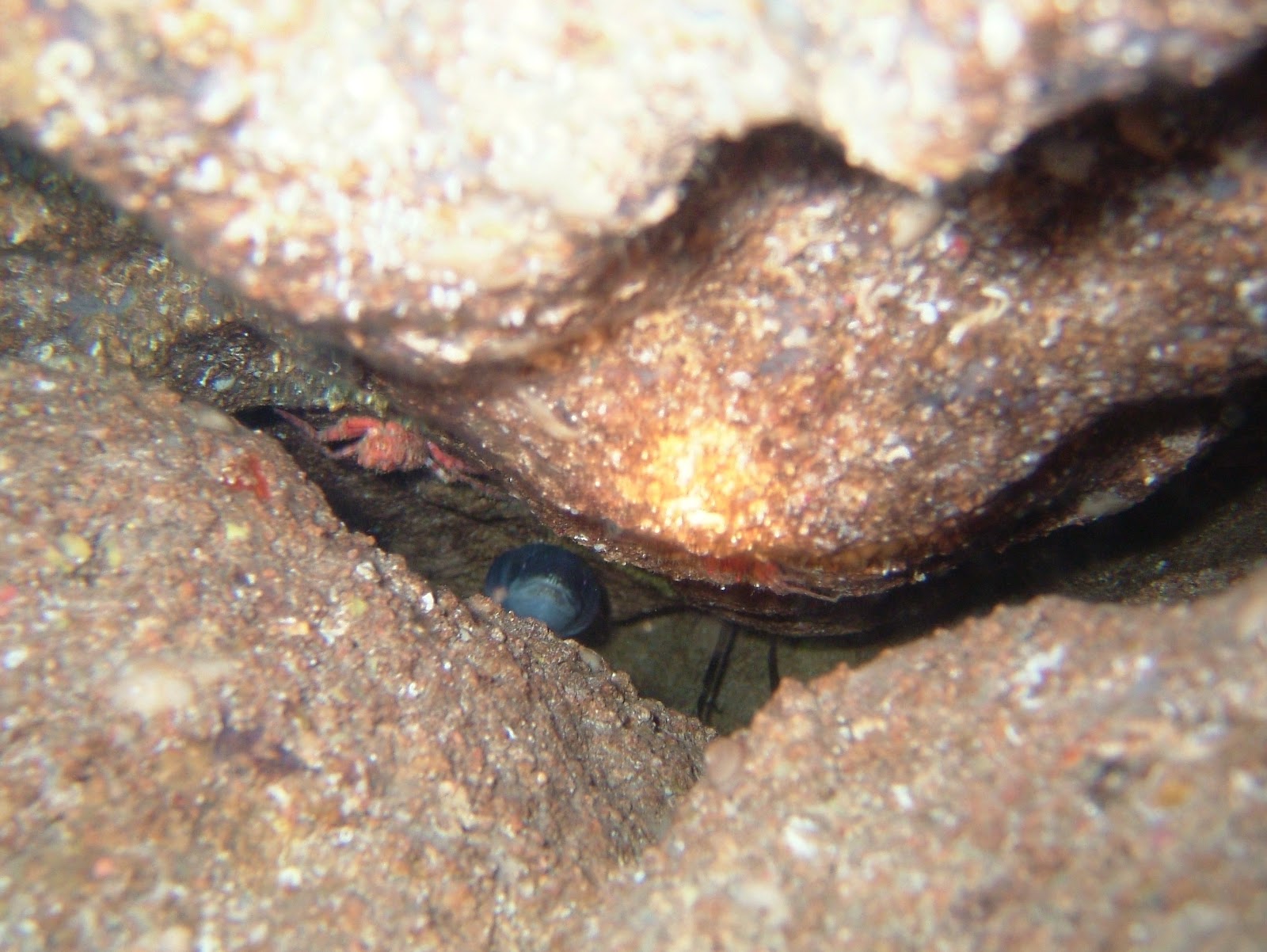
 Part of the dive included showing the other divers the conger, if he was at home.